
Propeller Definitions
Balancing
Matching each blades weight statically. This function takes out vibration allowing the prop to rotate smoothly
Blue Printing
Matching each propeller blade pitch quadrant from blade to blade. This function is for each blade to mechanically move forward equally
Customizing
Altering the propeller design. This function is to meet the boat/engine requirements for the ultimate performance gain. Used in racing, tournaments, fishing, water skiing, boat handling enhancement
Lab Finishing
Grinding the prop blade to create the most efficient thickness without losing the strength integrity. This function increases and enhances the performance of the propeller
Polishing
This function is for appearance, help keep the prop clean, slow down the rust reaction, and smoothes out potential stress risers
Prop Repairs
Restores the propeller back to its original factory specifications
Leading Edge
The edge of the propeller nearest to the boat cuts through the water first, starting at the hub it extends to the blade tip
Blade Tip
This is the farthest point that a propeller extends from the center of the hub to the outer radius of the blade
Trailing Edge
The edge of the propeller farthest away from the boat where the water leaves the blade
Cup
The cup on a propeller is designed to help lock the propeller in the water to reduce slippage and prevent cavitation. The cupped area is located on the trailing edge of the blade starting approximately 1" from the hub extending out to the blade tip
Pushing Face
This is the face of the propeller blade away from the boat. Also called the Pitch Face which faces the pitch block when repairing
Negative Face
This is the face of the propeller blade toward the boat
Blade Root
The thickest area of a propeller where the blade and the hub are joint together
Hub
The center of the propeller that fits over the propeller shaft
Over Hub Exhaust
Exhaust gasses flow over the hub and blades
Thru Hub Exhaust
Exhaust gasses flow through a barrel of outer hub to prevent exhaust gasses from flowing over the blades of the propeller
Rubber Hub
Inner hub bushing made of hard rubber, molded to a splined spindle to protect the drive train when shifting
ACR/Diffuser Ring
The flared ring used on through hub exhaust propellers. The ACR/Diffuser ring prevents the exhaust gasses from backing up on the blades which produces cavitation on take-off
Cavitation
The introduction of air on the propeller blades resulting from running a damaged propeller, or from sucking air from the surface of the water. A cavitating propeller is actually slipping and produces less thrust
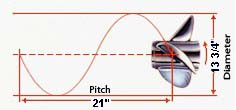
Pitch
The theoretical travel of a propeller through a mass per revolution. EX: a 21" pitch propeller moves approximately 21" per revolution
Straight Pitch
The pitch is constant or the same from leading edge to the trailing edge of the propeller
Progressive Pitch
The pitch increases from the leading edge to the trailing edge. EX: Leading edge measures 17", trailing edge measures 19" pitch - this is a 2" progressive pitch
Variable Pitch
The pitch increases from the leading edge to the trailing edge, and from the hub to the outer tip
Rake
The angle of the propeller blade in correspondence with the propeller shaft
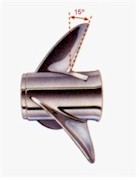
Foward Rake
Blades are angled toward the boat. Commonly used for inboard propellers and small outboard propellers
Aft Rake
Blades are angled back or away from the boat. Generally improves the ability of the propeller to operate in a cavatating or ventalating situation, such as the blades breaking the water surface. Higher rake angles can better hold the water off into the air by centrfuge force
Parabolic Rake
The rake of the blades are progressive. Can be either concave or convex
Diameter
The overall width of a propeller
Right Hand Rotation
The propeller turns clockwise on the shaft
Left Hand Rotation
The propeller turns counter-clockwise on the shaft
Performance Vent System (PVS)
A patented Mercury ventilation system, allows the boater to custom tune the venting of the propeller blades for maximum plane performance. On acceleration, exhaust is drawn out of the vent hole located behind each blade. When the next propeller blade strikes this aerated water, less force is required to push through this water allowing the engine RPM to rise more rapidly. Water flows over the vent holes once the boat is on plane sending exhaust through the exhaust passage. Varying the size of the exhaust holes engine RPM can be controlled, outboards perform better with venting and stern drives typically require less venting; if any at all.
